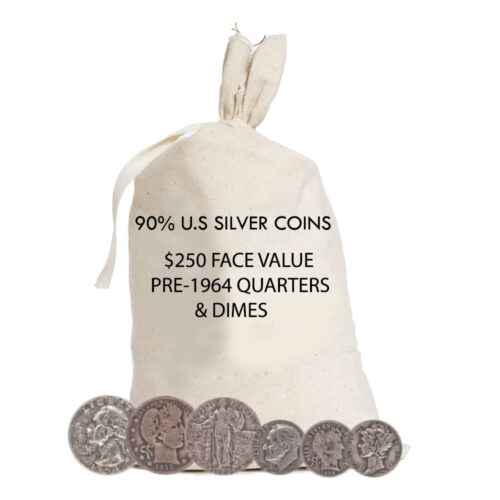
Prior to 1965, U.S. half-dollars, quarter dollars, and dimes were minted with 90% silver and 10% copper. Following the U.S. Coinage Act of 1965, all silver content was phased out of U.S. half-dollar coins. This caused Americas to hoard these coins because they understood that in time the intrinsic value of silver would maintain its purchasing power in years to come. Today this reality has unfolded as the silver content contained in each of these pre-1964 U.S. half dollars are many times more valuable than their initial face value. The silver content of a one-dollar face value of 90% pre-1964 half dollars is approximately .7234 troy ounces.
Today pre-1964 U.S. silver coins are referred to as “junk silver”. The term “junk silver” does not mean that these coins are junk at all; instead, it relates to the fact that they were circulated. Each $25 bag of mixed 90% junk silver half dollars are of average circulation and may contain a mix of 4 types of U.S. coins. Pre-1964 U.S. 90% silver half dollars may be one of three types: Kennedy Half Dollars (1964), Franklin Half Dollars (1948-1963), Liberty Walking Half Dollars (1916-1947), Barber Half Dollars (1892-1915).
Investors choose junk silver U.S. coins because it is an excellent way to get internationally recognized fractional silver and reasonable premiums. In the event of an economic meltdown when you may need to spend your silver, pre-1964 U.S. silver coins are an excellent way to buy smaller items. A single U.S. silver half dollar contains approximately .3617 troy ounces of silver.
Coin Highlights:
- Coin quantities vary and are based on a total face value of $25. All coins are shipped in a plastic or canvas bag and will equal exactly $25 face value of pre-1964 U.S. half dollars.
- Coin dates may range in years from 1892 to 1964.
- Contains approximately 18.0847 Troy Ounces of Silver.
- Produced by the U.S. Mint from 1892 to 1964.
- U.S. Government backed Sovereign Coins.